In the West, Aristotle, an ancient Greek philosopher Aristotle in 300 BC, explained the problem of rotating motion with bronze or cast iron gears in the "Mechanical Question". Both the famous Greek scholars Aristotle and Archimid both have studied gears. Greek's famous inventor Gutiisbios evenly inserts the sale on the edge of the round board workbench, so that it mesh with the sales wheel. He applied this institution to the engraving. This is about 150 BC. In the 100th BC, the inventor of Alexander Heron invented the mileage and used gears in the mileage meter. In the 1st century AD, gear transmission device was also used on the waterwheel powder producer made by the Architects of Rome. By the 14th century, gears began to use the clocks.
In the early Eastern Han Dynasty (1st century AD), there were human characters. During the Three Kingdoms period, the guidelines and Ji Lili drum cars had adopted the gear transmission system. The water rotation invented by the Jin Dynasty Du was passed to the stone mill through the gear to the stone mill. The earliest records of the gear transmission system in the history books are the description of the water transportation made by the Tang Dynasty and Liang Lingyu in 725. The water transport meter (see ancient Chinese timers) made in the Northern Song Dynasty uses a complex gear system. Mao Yuanyi of the Ming Dynasty recorded a gear shift transmission device with "Wu Beizhi" (in 1621). In the site of the Anwan Anwan City, Hebei, which was excavated in 1956, an iron spiny gear was found with a diameter of about 80 mm in diameter. Products during the Western Han Dynasty (206 to 24 AD). In 1954, a bronze spiny gear was unearthed in Yijiaya, Yongji County, Shanxi Province. Refer to the unearthed utensils of Tongkeng, it can be broken as the Qin Dynasty (221 to 206 BC) or the relics of the early Western Han Dynasty. Regarding the use of spiny gears, no text records have been found so far, speculating may be used for braking to prevent turning the axis. In 1953, a pair of bronze characters were unearthed in Hongqing Village, Chang'an County, Shaanxi Province. According to the analysis of the tomb structure and the situation of the tomb items, the pair of gears can be determined by the early Eastern Han Dynasty. Both rounds are 24 teeth with a diameter of about 15 mm. Hengyang and other places also found the same human character gear.
As early as 1694, French scholar Philippe de La Hire first proposed that the gradual opening can be used as a dental curve. In 1733, the Frenchman M.Camus proposed that the public law line of the rotation tooth contact point must pass the node on the central connection. A auxiliary instantaneous heart line follows the auxiliary teeth of the auxiliary tooth shape of the auxiliary instantaneous line of the auxiliary instantaneous line of the auxiliary instantaneous lines along the large wheel and small wheels. The curve is together, this is the Camus theorem. It considers the meshing state of the two teeth; it clearly establishes the concept of modern contact point trajectory. In 1765, Switzerland's L. in Switzerland EULER proposed the mathematical basis of the gradual analysis of tooth -shaped analysis, clarifying the relationship between the curvature radius and the center position of the curvature of the tooth shape. Later, Savary further completed this method and became the EU-LET-SAVARY equation. The Roteft Wulls contributed to the application of the gradient tooth shape. When he proposed that when the central distance changes, the gradual opening gear has the advantage of constant angular speed ratio. In 1873, German engineer Hoppe proposed that the gear of different teeth was gradually opened to the teeth when the pressure angle was changed, thus laid the ideological foundation of modern gears.
At the end of the 19th century, the principles of exhibition and toothing and the successive appearance of special machine tools and tools that used this principle to make the gear processing have more complete means, and gradually showed huge superiority. As long as the tooth cutting tool moves slightly from the normal meshing position, you can use a standard tool to cut the corresponding variable gears on the machine tool. In 1908, MAAG, Switzerland, studied the change method and created a processing tooth processing machine. Later, BSS, the United States Agma, and Germany DIN successively proposed a variety of calculation methods to gear variables.
In order to improve the service life of the power transmission gear and reduce its size, in addition to the improvement of materials, thermal treatment and structure, the arc -shaped gear has developed. In 1907, the British Frank Humphris first published an arc tooth shape. In 1926, Swiss Eruest Wildhaber obtained the patent right of the French -faced arc tooth -shaped diagonal gear. In 1955, the Soviet Union M. L. Novikov completed the practical research of arc -shaped gears and obtained the Lenin Medal. In 1970, R. R. R. M. Studer has obtained the US patent of double arc gears. This gear is increasingly valued by people and has played significant benefits in production.
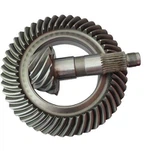
Gear is a toothed mechanical parts that can mesh. It is extremely widely used in mechanical transmission and the entire mechanical field. Modern gear technology has reached: the number of gear molds is 0.004 to 100 mm; the diameter of the gear is from 1 mm to 150 meters; the transmission power can reach 100,000 kilowatts; second.
With the development of production, the stability of gear operation is valued. In 1674, the Danish astronomer Rommer first proposed the use of the outer line as the tooth curve to obtain a stable gear.
During the 18th century industrial revolution, gear technology was developed at a high speed, and people conducted a lot of research on gears. In 1733, French mathematician Cami published the basic law of tooth mesh; in 1765, Swiss mathematician Euler suggested using a gradual opening as a tooth curve.
The teeth and tooth machines that appeared in the 19th century solved the problem of mass production of high -precision gears. In 1900, Puford was a differential device on the tooth machine, which could process the oblique gear on the tooth roller. From then on, the tooth roller rolling gear was popularized. Essence
In 1899, Lashe first implemented a transformer gear plan. The variable gear can not only avoid the cutting of the wheel tooth, but also can match the center distance and improve the carrying capacity of the gear. In 1923, Wildhabe, the United States, first proposed the gear of the arc tooth outline. In 1955, Sonovokov conducted an in -depth study of the arc gear, and the arc gear was applied to production. The carrying capacity and efficiency of this gear are high, but it is not as easy to manufacture as the gradual opening gear, and it needs to be further improved.