


Gear
Professional Customization Services
With the continuous development of the automotive industry, there is a growing demand for customization of components. With a strong design team and advanced production equipment, the company is able to customize production according to the specific needs of customers to meet the special requirements of different models and different working conditions.
Perfect supply chain system
A mature automotive gear manufacturer often has a perfect supply chain system, which can ensure the stable supply of raw materials and efficient delivery of finished products. The company has established long-term cooperative relationships with a number of high-quality suppliers, thus ensuring the continuity of production and product stability.
Strong production capacity
Scale production can reduce costs and improve efficiency. The company has a large-scale production base and advanced production lines, which can meet the demand for large-volume orders and provide customers with sufficient supply of goods.
Good market reputation
In the highly competitive auto parts market, good market reputation is an important guarantee for the sustainable development of enterprises. The company has won wide recognition from customers through its high-quality products and services, and established a good brand image and market reputation.
What is Gear
A gear is a rotating machine part having cut teeth, or cogs, which mesh with another toothed part in order to transmit torque. Two or more gears working in tandem are called a transmission and can produce a mechanical advantage through a gear ratio and thus may be considered a simple machine. Geared devices can change the speed, torque, and direction of a power source. The most
common situation is for a gear to mesh with another gear, however a gear can also mesh a non-rotating toothed part, called a rack, thereby producing translation instead of rotation.
-
 Tractor Ring GearWith the rapid development of agricultural mechanization, tractors have become the core equipmentAdd to Inquiry
 -
 Tractor High Low GearTractor high low gear can achieve the best power output in different working environments, helpingAdd to Inquiry
 -
 New Holland GearNew Holland gears are designed for agricultural equipment to provide stable and efficient powerAdd to Inquiry
 -
 Tractor TransmissionAn efficient transmission system can improve overall operating efficiency, effectively reduce fuelAdd to Inquiry
 -
 Tractor GearboxDriven by modern agricultural mechanization, the performance of tractor gearboxes directly affectsAdd to Inquiry
 -
 New Holland Tractor GearTractor gears are high-performance, durable key components designed for the agricultural machineryAdd to Inquiry
 -
 Tractor GearTractor gears are an indispensable core transmission part in agricultural machinery, injectingAdd to Inquiry
 -
 Automotive Transmission Spur GearGear / shaft from a truck transmission. We have mature production line and full processes toAdd to Inquiry
 -
 Automotive Transmission Helical GearHelical gears are power transmission components primarily used to decrease speed and increaseAdd to Inquiry
 -
 Involute GearThe involute gear profile is the most commonly used system for gearing today, with cycloid gearingAdd to Inquiry
 -
 Manual Transmission Spur GearSpur gears are the most easily visualized common gears that transmit motion between two parallelAdd to Inquiry
 -
 Manual Transmission Helical GearHelical gears are similar to spur gears except that their teeth are cut at an angle to the holeAdd to Inquiry


- Tel: +86-579-88301121
- Mob: +86-13858988130
- Email: jhjgcl@sina.com
- Add: ChengNan Industrial District, LanXi, Zhejiang, P.R.C.

• Gear drives provides large range of speed and torque for same input power, with more accurate timing than a chain system does, less friction loss and noise.
• Gear is positive drive; hence large velocity ratio can be obtained with minimum space.
• Gears are mechanically strong, so higher loads can be lifted.
• Gears are used for transmission of large H.F.
• They are used for transmitting motion over small centre distance of shafts
• They are used for large reduction in speed and for transmission of torque.
• Gears require only lubrication; hence less maintenance is required.
• Using gear systems, we can transmit motion between non-parallel intersecting shafts.
• They are used for positive drive, so its velocity ratio remains constant.
• They have long life, so the gear system is very compact
Types of Gears
Spur gear
Spur gears are one of the most popular types of precision cylindrical gears. These gears feature a simple design of straight, parallel teeth positioned around the circumference of a cylinder body with a central bore that fits over a shaft.
In many variants, the gear is machined with a hub that thickens the gear body around the bore without changing the gear face. The central bore can also be broached to allow the spur gear to fit onto a spline or keyed shaft.
Spur gears are used in mechanical applications to increase or decrease the speed of a device or multiply torque by transmitting motion and power from one shaft to another through a series of mated gears.
Spur gears are used to transfer motion and power from one shaft to another in a mechanical setup. This transference can alter machinery’s operating speed, multiply torque, and allow for the fine-tuned control of positioning systems. Their design makes them suitable for lower-speed operations or operational environments with a higher noise tolerance.
MORE: What is Spur Gear?
Helical gear
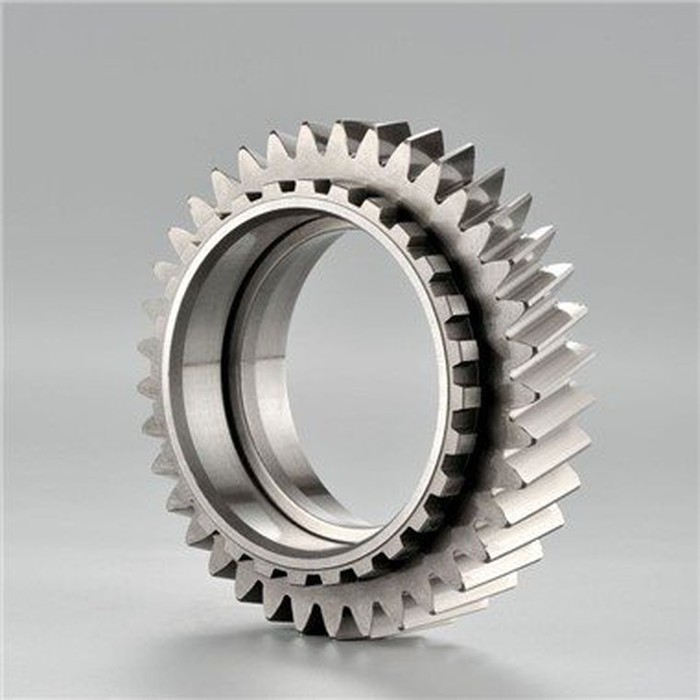
Helical gears are one type of cylindrical gear with a slanted tooth trace. Compared to spur gears, they have a larger contact ratio and excel in quietness and less vibration, and are able to transmit large force. A pair of helical gears have the same helix angle but the helix hand is opposite.
Helical gears and spur gears are two of the most common gear types and can be used in many of the same applications. Spur gears are simple and inexpensive to manufacture, but helical gears offer some important advantages over spur gears.
The teeth of a helical gear are set at an angle (relative to the axis of the gear) and take the shape of a helix. This allows the teeth to mesh gradually, starting as point contact and developing into line contact as the engagement progresses.
One of the most noticeable benefits of helical gears over spur gears is less noise, especially at medium- to high speeds. Also, with helical gears, multiple teeth are always in mesh, which means less load on each individual tooth. This results in a smoother transition of forces from one tooth to the next, so that vibrations, shock loads, and wear are reduced.
Gear rack
Same sized and shaped teeth cut at equal distances along a flat surface or a straight rod is called a gear rack. A gear rack is a cylindrical gear with the radius of the pitch cylinder being infinite. By meshing with a cylindrical gear pinion, it converts rotational motion into linear motion.
Gear racks can be broadly divided into straight tooth racks and helical tooth racks, but both have straight tooth lines. By machining the ends of gear racks, it is possible to connect gear racks end to end.
Bevel gear
A bevel gear is a toothed rotating machine element used to transfer mechanical energy or shaft power between shafts that are intersecting, either perpendicular or at an angle. This results in a change in the axis of rotation of the shaft power. Aside from this function, bevel gears can also increase or decrease torque while producing the opposite effect on the angular speed.
A bevel gear can be imagined as a truncated cone. At its lateral side, teeth are milled which interlock to other gears with its own set of teeth. The gear transmitting the shaft power is called the driver gear, while the gear where power is being transmitted is called the driven gear.
The number of teeth of the driver and driven gear are usually different to produce a mechanical advantage. The ratio between the number of teeth of the driven to the driver gear is known as the gear ratio, while the mechanical advantage is the ratio of the output torque to the input torque.
Spiral bevel gear
Spiral bevel gears are bevel gears with curved tooth lines. Due to the higher tooth contact ratio, they are superior to straight bevel gears in efficiency, strength, vibration, and noise. On the other hand, they are more difficult to produce.
Also, because the teeth are curved, they cause thrust forces in the axial direction. Within the spiral bevel gears, the one with zero twisting angles is called zerol bevel gear.
Screw gear
Screw gears are a pair of same hand helical gears with the twist angle of 45° on non-parallel, non-intersecting shafts. Because the tooth contact is a point, their load carrying capacity is low and they are not suitable for large power transmission.Since power is transmitted by the sliding of the tooth surfaces, it is necessary to pay attention to lubrication when using screw gears. There are no restrictions as far as the combinations of a number of teeth.
Double helical gear
Double helical gears are a variation of helical gears in which two helical faces are placed next to each other with a gap separating them. Each face has identical, but opposite, helix angles.
Employing a double-helical set of gears eliminates thrust loads and offers the possibility of even greater tooth overlap and smoother operation. As the helical gear, double helical gears are commonly used in enclosed gear drives.
Herringbone gear
Herringbone gears are very similar to the double-helical gear, but they do not have a gap separating the two helical faces. Herringbone gears are typically smaller than the comparable double helical and are ideally suited for high shock and vibration applications. Herringbone gearing is not used very often due to its manufacturing difficulties and high cost.
Hypoid gear
Hypoid gears look very much like spiral bevel gear, but unlike spiral bevel gears, they operate on shafts that do not intersect. In the hypoid arrangement, because the pinion is set on a different plane than the gear, the shafts are supported by the bearings on either end of the shaft.
Miter gear
Miter gears are bevel gears with a speed ratio of 1. They are used to change the direction of power transmission without changing speed. There are straight miter and spiral miter gears. When using the spiral miter gears it becomes necessary to consider using thrust bearings since they produce thrust force in the axial direction.
Besides the usual miter gears with 90° shaft angles, miter gears with any other shaft angles are called angular miter gears.
Worm gear
A screw shape cut on a shaft is the worm, the mating gear is the worm wheel, and together on non-intersecting shafts is called a worm gear. Worms and worm wheels are not limited to cylindrical shapes. There is the hour-glass type which can increase the contact ratio, but production becomes more difficult.
Due to the sliding contact of the gear surfaces, it is necessary to reduce friction. For this reason, generally, hard material is used for the worm, and soft material is used for the worm wheel. Even though the efficiency is low due to the sliding contact, the rotation is smooth and quiet. When the lead angle of the worm is small, it creates a self-locking feature.
Internal gear
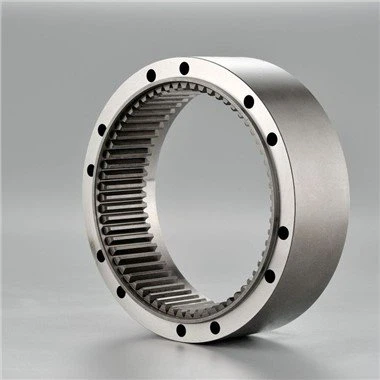
Internal gears have teeth cut on the inside of cylinders or cones and are paired with external gears. The main use of internal gears is for planetary gear drives and gear-type shaft couplings. There are limitations in the number of teeth differences between internal and external gears due to involute interference, trochoid interference, and trimming problems.
The rotational directions of the internal and external gears in the mesh are the same while they are opposite when two external gears are in the mesh.
How Gears Work



Gears are mechanical devices that are usually circular in shape and have teeth like structures on the edges or top. The gears are used in many machines to provide rotational force and torque for its working. The gears work in pairs, which helps in preventing slipping, one gear’s teeth engaged in the other. Gears are machines that have teeth and are placed on the rotating shafts. If the gear pair is circular then the rotary speed and the torque produced is constant. But if it is non circular then the speed and torque ratio may vary.
For a constant speed and non varying torque it is important to carefully shape the profile of the gear. The smaller pair of gears, also called pinion, is on the driving gear. The pair will move and reduce the speed and increase the torque of the gear. But if the pinion is on the driven shaft then the speed will increase and torque will decrease. The shaft that the gear pair is on must be placed close but with space between. The rotating shaft can be parallel, non parallel, intersecting, or non intersecting. The gears connect each other with a rotating shaft. This shaft works as a lever. The main function of gears is to transfer energy or rotation from one part to another. Many gears can be connected at one time. Three things can occur in gears such as:
• Increase speed
If two wheels are connected to each other and one has 40 teeth and the other has 20 teeth, then the smaller one with 20 teeth will move twice the speed as the first one to keep up the pace of both wheels. The speed will increase but the force will be reduced for the smaller wheel to move.
• Increase force
If the smaller wheel has more teeth rather than the bigger one then its speed will slow down and force will increase. It means more force will be required by the smaller wheel to move.
• Change direction
If the two gears that are connected to each other move, then one gear will move clockwise and the other will move anti clockwise. If we want to turn the angles of its movement then we have to use a special type of gears that are specific for this function.
The Ways to Use Gears in Mechanical Design Situations
Use two spur gears of the same diameter in mesh so that when the driver gear is reversed, the driven gear is also reversed. You can obtain a working piece grasping mechanism by utilizing this motion. Work pieces of various sizes can be accommodated by adjusting the opening angle of the grasping claw resulting in a versatile grasping mechanism design.
There is the Geneva mechanism as an intermittent motion mechanism. However, because of need for the specialized mechanical components, it is high priced. By using the missing teeth gears, a low cost and simple intermittent mechanism can be obtained.
By missing teeth gear, we mean a gear in which any number of gear teeth have been removed from their roots. The gear which is mated to the missing teeth gear will rotate as long as it is meshed together but will stop as soon as it encounters the missing teeth section of the driving gear. However, it has the disadvantage of shifting when external force is applied while the gears are disengaged. In these cases, it is necessary to maintain its position by means such as using a friction brake.
By mounting a one-way clutch (a mechanism that allows rotational motion in one direction only) in one stage of a gear train of a gear speed reducer, you can create a mechanism which transmits motion in one direction but idles in reverse.
By using this mechanism, you can create a system that operates a motor when the electric power is on, but when the power is cut, it moves the output shaft by a spring force.
By internally mounting a spring (torsion coil spring or spiral spring) that winds in the rotational direction in a gear train, the speed reducer is operated as the spring is wound. Once the spring is completely wound, the motor is stopped and the electromagnetic brake built into the motor holds this position.
When the electricity is cut, the brake is released and the spring force will drive the gear in the opposite direction to when the motor was driving. This mechanism is used to close valves when the power is lost (emergency) and is called “spring return type emergency shutoff valve”.
Gears are a very useful transmission mechanism that is used to transmit rotation from one axis to another. As mentioned earlier, you can change the output speed of a shaft with gears. Let’s say you have a motor that spins at 100 revolutions per minute and you just want it to spin at 50 revolutions per minute.
You can use a gear system to decrease the speed (and also increase the torque) so that the output shaft rotates at half the engine speed. Gears are commonly used in high load situations because the teeth of the gear allow finer, more discreet control of the movement of a shaft. This is an advantage that gears have over most pulley systems.
• Axis: The axis of revolution of the gear, where the shaft passes through
• Teeth: The jagged faces projecting outward from the circumference of the gear, used to transmit rotation to other gears. The number of teeth on a gear must be an integer. Gears only transmit rotation when their teeth mesh and have the same profile.
• Pitch Circle: The circle that defines the “size” of the gear. The pitch circles of two intermeshing gears must be tangential so that they can intermesh. If the two gears were instead two disks driven by friction, the circumference of those disks would be the pitch circle.
• Pitch Diameter: The pitch diameter refers to the working diameter of the gear, a.k.a., the diameter of the pitch circle. You can use the pitch diameter to calculate how far away two gears should be: The sum of the two pitch diameters divided by 2 corresponds to the distance between the two axes.
• Diametral Pitch: The ratio of the number of teeth to the pitch diameter. Two gears must have the same diametrical pitch to mesh.
• Circular Pitch: The distance from a point on one tooth to the same point on the adjacent tooth, measured along the pitch circle. (so that the length is the length of the arc rather than a line).
• Module: The module of gear is simply the circular pitch divided by pi. This value is much easier to handle than the circular pitch because it is a rational number.
• Pressure Angle: The pressure angle of a gear is the angle between the line that defines the radius of the pitch circle and the point where the pitch circle intersects a tooth, and the line tangent to that tooth at that point. Standard print angles are 14.5, 20, and 25 degrees. The pressure angle affects how the gears touch and how the force is distributed along with the tooth. Two gears must have the same contact angle for meshing.
Materials Used in Gears
Rolling is a metal forming process that involves the use of a set of rollers that alter the shape of the metal, improve its uniformity, and enhance its mechanical properties. The rolling process is divided into cold rolling and hot rolling, which have distinct characteristics that make steel suitable for different applications. When selecting steel to manufacture gears, it is essential to understand the differences between the two methods of manufacturing since they affect the performance of the metal.
Cold rolled steel is an iron based alloy that is made from one or many different kinds of chemical compositions with the majority having a low carbon content. For the manufacture of gears, low to medium carbon steel is used. Cold rolled steel is hot rolled and undergoes various processes to improve its dimensional and mechanical properties. During the rolling process, cooled heated rolled steel passes through a series of rollers at room temperature under high pressure. It is an expensive process that achieves tight dimensional tolerances and an improved surface finish.
In the case of cold rolled steel for gears, the metal is rolled at different thickness into sheets or plates that can be used for various gear manufacturing methods. The cold rolling process produces steel that is 20% stronger than hot rolled steel, which makes it ideal for high stress applications. Its better surface finish makes cold rolled steel able to produce gears with a smooth, even finish that have a shiny surface. Since cold rolled steel does not shrink after forming, gears that are manufactured from it are dimensionally accurate and precise.
Hot rolled steel is not used for the manufacture of gears due to its rough scaly surface and oily finish. Although hot rolled steel costs less, has high strength, and is available in large quantities, it is unable to produce components that have tight tolerances and precision shapes, which automatically disqualifies it from gear production.
Tool steel alloys have a high carbon chrome content with differing amounts of molybdenum, cobalt, vanadium, and other essential elements. They are ideal for gear production due to their ability to withstand high loads, ability to endure impact at room temperature, and exceptional wear resistance. Tool steel alloys come in an annealed condition, which softens the material such that it can be machined or formed. The grades of tool steel include MTEK A2, MTEK A6, MTEK D2, and MTEK D5, and MTEK H13.
The wide use of tool steel is due to its hardness, resistance to wear, toughness, and resistance to high temperatures. There are seven categories of tool steel, which include water hardened, hot worked, cold worked, shock resistant, molded, and special purpose. Of these categories, cold worked tool steel is used the most for the production of gears.
The strength and carbide formation of tool steels is due to their high carbon content with nickel and cobalt giving it high temperature resistance. The various carbide metals, chromium, molybdenum, tungsten, and vanadium, give tool steel its hardness and wear resistance. Its carbon content ranges between 0.7% and 1.5% of weight with some tool steels having 2.1%.
The manufacture of gears using tool steel includes cutting, forming, shearing, and stamping of sheets or plates of the metal.
The first choice of material for gears that require superior strength are iron alloys with carbon steel used for all types of gearing applications because it is easy to machine, is wear resistant, can be hardened, is widely available, and is inexpensive. The classifications of carbon steel include mild steel, medium carbon steel, and high carbon steel. Mild steel alloys have less than 0.3% carbon while high carbon steels have greater than 0.6% carbon content. Mild, medium, and high carbon steels are used to manufacture spur gears, helical gears, gear racks, bevel gears, and worm gears.
Carbon steels can be induction or laser hardened while other steels have aluminum, chromium, copper and nickel added to create stronger steels that are easier to machine, are more corrosion resistant than carbon steel, and are used to make the same gears as mild, medium, and high carbon steel alloys. The added strength of the special alloyed steels makes it possible for gears made from them to endure heavier loads with greater resistance to wear.
A special alloy of steel is stainless steel that has an 11% chromium content and is alloyed with nickel, manganese, silicon, phosphorus, sulfur, and nitrogen. Stainless steel is divided into ferritic, austenitic, martensitic, and precipitation hardened stainless steels, each of which has special characteristics and properties.
Ferritic stainless steels are 400 series stainless steels while austenitic stainless steels are 300 series stainless steels. Of the four stainless steel types, stainless steel alloy 304, with an 18% chromium and 8% nickel content, is the most used and most popular. For the production of gears, stainless steel 303 is used with a 17% chromium content and 1% of sulfur added. The addition of sulfur improves the machinability of stainless steel 303.
In applications that require gears with corrosion protection, stainless steel 316 is used due to its 16% chromium, 10% nickel, and 2% molybdenum content. The gears that are normally made from stainless steels 316 and 303 are spur gears, helical gears, and bevel gears.
Copper alloys are used for the manufacture of gears that will be subjected to corrosive conditions or require a non-magnetic material. The most commonly used copper alloys for gear production are brass, phosphor bronze, and aluminum bronze. Brass is an alloy of copper and zinc, which changes the ductility of the alloy.
When brass has a low zinc content, it is very ductile. With a high zinc content, brass is less ductile. The copper content of brass makes it easy to machine gears and makes them antimicrobial. Gears that are made from brass are spur gears and gear racks, which are used in low load conditions such as instrument drives.
Phosphor bronze is a combination of copper, tin, and phosphorus. The addition of tin increases the strength of copper and enhances its corrosion resistance while the addition of phosphorus improves copper’s wear resistance and stiffness. The combination of alloys with phosphorus makes bronze alloy gears an excellent choice for high friction drive components. This copper alloy is used for the production of worm gears due to the alloy's ability to resist degradation when lubricated.
Another highly durable and wear resistant copper alloy is aluminum bronze that is a combination of aluminum, iron, nickel, manganese, and copper. It has higher wear resistance than phosphor bronze alloys and superior corrosion resistance. The improvement in its wear resistance is due to the addition of iron. The resistance of this unique alloy makes it possible to design gears to withstand oxidation, salt water, and organic acids. Its strength and durability makes it ideal for handling loads that are far larger than those handled by phosphor bronze. Gears produced from aluminum bronze are crossed axis helical gears and worm wheels.
One of the benefits of bronze gears is their self lubricating properties that reduce the need for lubricating worm gear assemblies. This characteristic simplifies maintenance and results in smoother operation with lower friction loss.
Aluminum alloy gears are used as an alternative to iron gears in applications that require a high strength to weight ratio since aluminum is one third the weight of steel alloys of the same size. The passivation layer of aluminum protects aluminum gears from oxidation and corrosion. Aluminum alloy gears are more expensive than carbon steel gears but less expensive than stainless steel gears. They are easy to machine, which offsets the increased cost.
The aluminum alloys that are used in gear manufacturing are 2024, 6061, and 7075. Of the three alloys, 2024 is similar to aluminum bronze since it is an alloy containing aluminum and copper. The addition of copper to 2024 increases its strength but lowers its resistance to corrosion. Aluminum alloy 7075 is a combination of zinc, magnesium, and aluminum, which is a high strength alloy that is resistant to stress loading. Aluminum, silicon, and magnesium combine to make aluminum alloy 6061, which is a medium strength alloy with weldability and corrosion resistance.
All three of the alloys can be heat treated to improve their hardness. The gears that are made from aluminum include spur gears, helical gears, straight tooth bevel gears, and gear racks. Aluminum gears are used for moderate temperature applications since they begin to degrade at 204°C (400°F).
The plastics used to produce plastic gears include polyacetal, polyphenylene sulfide, nylon, polyamide, polycarbonate, and polyurethane. The use of plastics for gear production is due to their reliability and their ability to resist heat, pressure, and corrosion.
Although plastic gears can be made from a single polymer, the properties and characteristics of plastic gears are radically enhanced when different plastics are blended to form a gear. Their resistance to tension, pressure, heat, and corrosion drastically improves due to the combination of the positive properties of the various plastics.
One of the difficulties with metal gears is the amount of noise they produce during operation. The low density of plastics reduces the resonance of plastic gears providing a quieter work environment. It is this soundproofing quality that makes plastic gears a highly sought after gear solution.
Two of the factors that make plastic gears so popular, aside from their sound suppression, is their cost and effectiveness. The materials used to produce plastic gears cost far less than any of the other gear materials. This particular factor is further enhanced by the longevity of plastic gears, when amortized over several years of outstanding performance.
The main preference for plastic gears is thermoplastic polyesters that are more dimensionally stable than nylon, which absorbs moisture that changes its properties and dimensions. The popularity of thermoplastic polyesters is its dimensional stability and its self lubricating properties.
The list of the benefits of plastic gears is very long and includes design flexibility, low cost, weight that is 15% to 20% less than steel, noise reduction, efficiency, accuracy, and durability. All of these characteristics are a necessity for gears that are normally constantly in motion and under stress. The efficiency of plastics is based on their low friction coefficient since less horsepower is required to operate them.
Our Factory
Founded in 1992, JinHua JingGong automotive gear Ltd., Co. was originally established in JinHua, ZheJiang. Major products are transmission gear and gear shaft parts. As a 30-year-old mechanic manufacturing company, the persistency on automotive industry has always driven us to be creative and keep forging ahead. Currently, we have capability to produce 500,000 parts per year and independently develop new transmission gear boxes, and more importantly, we can turn a blueprint into a fact. Holding the IATF 16949 certificate, JingGong is currently a supplier of DFAC. Our products cover full-range of transmission field, including trucks, construction machinery, farm machinery and mining machinery. Also, we have developed transmission parts of first batch EV trucks in China.

Certificate

FAQ
We're professional gear manufacturers and suppliers in China, specialized in providing high quality customized service. We warmly welcome you to buy high-grade gear at competitive price from our factory.
Spiral Gear, truck half shaft, gear box for airboat