


Electric Motor Shaft
Professional Customization Services
With the continuous development of the automotive industry, there is a growing demand for customization of components. With a strong design team and advanced production equipment, the company is able to customize production according to the specific needs of customers to meet the special requirements of different models and different working conditions.
Perfect supply chain system
A mature automotive gear manufacturer often has a perfect supply chain system, which can ensure the stable supply of raw materials and efficient delivery of finished products. The company has established long-term cooperative relationships with a number of high-quality suppliers, thus ensuring the continuity of production and product stability.
Strong production capacity
Scale production can reduce costs and improve efficiency. The company has a large-scale production base and advanced production lines, which can meet the demand for large-volume orders and provide customers with sufficient supply of goods.
Good market reputation
In the highly competitive auto parts market, good market reputation is an important guarantee for the sustainable development of enterprises. The company has won wide recognition from customers through its high-quality products and services, and established a good brand image and market reputation.
What is Electric Motor Shaft
The motor shaft is the main support and connection for the armature portion of the motor, as well as the power output component. It is usually a cylindrical component that protrudes from the motor and its housing, and its main function is to convert the energy of the motor into power for practical applications. The design and material selection of the motor shaft is critical to ensure the efficiency and stability of the motor. Common applications include power steering control systems, small appliance motors, power tool motors, and specialized components.
-
 Motor ShaftThe main component in most rotating equipment is the motor shaft. A shaft is a mechanical sectionAdd to Inquiry
 -
 Rotor ShaftThe rotor shaft is a central component of the electric motor. The rotor shaft is the carrier shaftAdd to Inquiry
 -
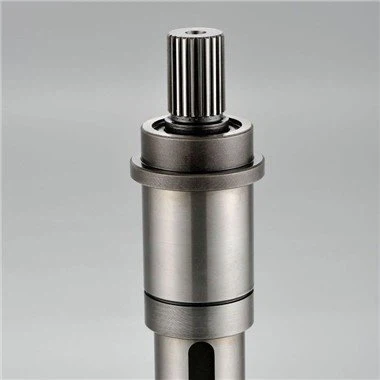 Spindle ShaftA transmission shaft (also known as shaft) is a rotating machine element with circular crossAdd to Inquiry
 -
 Splined ShaftA splined shaft is characterized by the deep grooves, or splines, cut along the entire length ofAdd to Inquiry


- Tel: +86-579-88301121
- Mob: +86-13858988130
- Email: jhjgcl@sina.com
- Add: ChengNan Industrial District, LanXi, Zhejiang, P.R.C.

• Lightweight design can be used employing a tube and as a built version.
• A combination of various materials is possible.
• Motor shafts are ready for installation or as a semi-finished component close to the final contour.
• Low weight (conserve resources) and high transmission capacity
• Splines can be changed according to customer requirements
Construction of a Electric Electric Motor Shaft
Choosing the appropriate material can improve reliability. Once considering the best substance for the device and its shaft, you should primarily think about the cost.
The material used for a typical motor shaft is mild steel, but once high strength is needed, alloy steel such as chromium-vanadium, nickel, and nickel-chromium is used.
Most motor constructors apply SAE 1045 in either hot-rolled (HRS) or cold-rolled steel (CRS). C1045 is a moderate carbon, moderate tensile steel provided as forged or normalized. This steel demonstrates appropriate toughness, strength, and wear resistance.
It is used for bolts, axles, crankshafts, forged connecting rods, light gears, torsion bars, guide rods, etc.
Other substances include sulfurized SAE 1137, SAE 1117, SAE 1144, cold-rolled SAE 1018, and hot-rolled SAE 1035. A ground stock of any substance is employed on particular CNC turning machines.
In general, the sulfurized and cold-rolled steels will increase prices relatively 15% more than HRS and will perform better. Machining trials are required to be implemented in order to control the extra cost. Because all shaft-turning devices perform differently, there is no established substance or machining maintenance.
On a cost-per-pound explanation, hot-rolled plain carbon steel is more cost-effective than cold-rolled sulfurized type. However, there are some drawbacks when we want to employ them. Hot-rolled material should be sized greater than cold-rolled form because of the lack of outer diameter (OD) monitoring in the rolling procedure.
Manufacturers of electric motors must evaluate whether the larger-size and lower-material-cost hot-rolled bar stock are more or less costly than cold-rolled bar stock.
Residual stresses, hard and soft spots, voids, and other substance deficiencies are typical with hot-rolled material, which makes it more problematic for machining. The issue with some high-strength steels is the hardest side is just the outside layers, so when the shaft is use, there is less strength.
Conducting trials will help you select the best substance between CRS, HRS, sulfurized, and non-sulfurized materials.
Industrial Electromechanical Repair Services (or IER Services) was presented in 2011 to supply effective, fast, repair services of electromechanical instruments of all kinds including DC and AC motors, variable frequency drives, pumps, dynamic balancing, and more. They also support shaft alignment services.
Not only do they provide their customers with quality motor shaft fixing, but they also provide special electric motor shafts used in other valves, pumps, motors, and hydraulics.
Most motor manufacturers apply SAE 1045 in either cold-rolled (CRS) or hot-rolled steel (HRS). The hot-rolled carbon steel material, on a cost-per-pound foundation, is cheaper than the cold-rolled one. But there are some tradeoffs such as size considerations in the rolling process.
Constructors of electric devices estimate whether the lower-material-cost and larger-size hot-rolled bar stock are more or less expensive than cold-rolled bar stock.
The hot-rolled substance, by the very nature of its features, has soft and hard spots, voids, residual stresses, and other material deficiencies, making it more problematic for machining. The main drawback with some high-strength steels is that the hardest section is just the outside layers, so once the shaft is machined down, the system will miss the strength.
Machine trials require to be conducted to choose the best option among various materials.

Appropriate motor shaft alignment improves the performance life span of rotating devices. To obtain this, parts that are the most probably to fail must be designed accurately to perform within their acceptable design limits.
The Advanced Manufacturing Office of the U.S. Department of Energy has defined some information and tips regarding misalignment and key factors for alignment. The following information is the summarized tips we should consider about the importance of motor shaft alignment:
While misalignment has no measurable impact on the efficiency, an appropriate shaft alignment improves the efficient and smooth transfer of energy from the motor to the driven instrument. Otherwise, a wrong alignment happens once the centerlines of the driven equipment and the motor shafts are not in line with each other. Misalignment creates additional noise, vibration, premature failure of bearings, couplings or shafts, and coupling- and bearing-temperature increases.
Types of Electric Motor Shaft Misalignment
Angular misalignment happens while the motor is installed at an angle to the driven equipment. If the centers of the driven device and the motor shafts were to be extended, they actually cross each other, rather than run or superimpose along a standard centerline. The “space” (space difference between coupling faces) or slope difference of the motor shaft when compared with the slope of the fixed machine shaft can happen in the vertical direction, horizontal direction, or both. Angular misalignment particularly can result in severe damage to the driven instrument and the motor.
Parallel misalignment occurs once the two shaft centerlines are in a parallel configuration, but not in the same line. There are two forms of parallel misalignment as shafts may be offset vertically (positioned at different elevations), horizontally (displaced to the left or right), or both.
Combination misalignment happens once the motor shaft suffers from both parallel misalignment and angular one simultaneously. This is the most traditional misalignment situation encountered in the system
Electric Motor Shaft Materials
Carbon steel
Carbon steel is a very common choice for motor shafts due to its good machinability, tensile strength, and ability to undergo heat treatment for improved hardness. An example is grade 1045 carbon steel, frequently used for medium-strength applications like electric motor shafts or pump shafts.
Stainless steel
Stainless steel is chosen when corrosion resistance is a key requirement. For example, 304 and 316 stainless steel, known for their excellent corrosion resistance, are used in applications exposed to water or corrosive chemicals, like marine environments or chemical processing plants.
Alloy steel
For motor shafts that need high strength and toughness, alloy steel is a good choice. Types like 4140 or 4340 alloy steel are often used in heavy-duty applications such as large industrial motors or machinery.
Brass
For applications where high strength isn’t the priority but good machinability and corrosion resistance, are required, brass is a solid choice. Brass shafts are often found in appliances and light-duty machinery.
Aluminum
This material is lightweight, corrosion-resistant, and relatively easy to machine, making it suitable for applications where weight is critical. Small motor shafts for drones or other lightweight devices often use aluminum.
Titanium
Used in high-performance applications, titanium provides a high strength-to-weight ratio and excellent corrosion resistance. Due to these properties, it’s often used for motor shafts in aerospace applications.
Nickel alloys
These are used in highly demanding applications due to their excellent high-temperature strength and corrosion resistance. An example is Inconel, which might be used for motor shafts in turbines or other high-temperature environments.
Cost Considerations In Electric Motor Shaft CNC Machining
Material Costs
The type of material used to create the motor shaft can greatly influence the cost. More common materials like carbon steel are typically less expensive than high-performance materials such as titanium or nickel alloys. The chosen material must balance cost with the specific requirements of the motor, such as strength, corrosion resistance, and heat tolerance.
01
Machining Processes
Different machine processes come with varying cost implications. More complex operations like Electrical Discharge Machining (EDM) or laser machining typically cost more than standard processes like turning or milling due to their higher equipment, maintenance, and operational costs.
02
Tooling Costs
The cost of the cutting tools used in the machining process is another key consideration. Tools will wear over time and must be replaced, and some materials that are harder or more abrasive can increase tool wear, leading to higher tooling costs.
03
Labor Costs
The complexity of the machining process will impact labor costs. The labor cost will increase if the shaft requires complex machining or manual finishing work. Additionally, training costs for operators might be higher for more advanced machining processes.
04
Quality Control
Implementing rigorous quality control procedures is critical to ensuring the final product performs as expected, but this can also add to the cost. This might involve investment in measurement and testing equipment and time spent on inspection.
05
Passivating: This process, commonly used on stainless steel, involves cleaning the surface with a solution, typically an acid, that removes free iron and other contaminants. This allows a passive chromium oxide layer to form, improving corrosion resistance.
Carburizing: Carburizing is a heat treatment process that enriches the surface layer of low-carbon steel with carbon. This increases surface hardness while maintaining the ductility of the core, enhancing wear resistance.
Nitriding: Nitriding is another heat treatment process that diffuses nitrogen into the surface of the steel, creating a hard, wear-resistant layer. This is often used when high surface hardness and fatigue resistance are required.
Induction Hardening: This process uses electromagnetic induction to heat the shaft surface before quickly cooling it or quenching to harden it. This is used to enhance the shaft’s wear resistance and strength.
Electroplating: Electroplating deposits a thin layer of metal, such as nickel or zinc, onto the surface of the shaft. This provides additional corrosion resistance and, in some cases, improved wear resistance.
Anodizing: Used primarily for aluminum shafts, anodizing creates a hard, corrosion-resistant oxide layer on the shaft surface. It also allows for color dyeing for aesthetic purposes.
Phosphating: This process forms a layer of insoluble, crystalline phosphates on the surface of the shaft, which can provide corrosion resistance, as well as a good base for further coatings or paint.
Thermal Spraying: A coating material is heated and sprayed onto the shaft surface during this process. This can provide enhanced corrosion resistance, wear resistance, and thermal insulation.
Our Factory
Founded in 1992, JinHua JingGong automotive gear Ltd., Co. was originally established in JinHua, ZheJiang. Major products are transmission gear and gear shaft parts. As a 30-year-old mechanic manufacturing company, the persistency on automotive industry has always driven us to be creative and keep forging ahead. Currently, we have capability to produce 500,000 parts per year and independently develop new transmission gear boxes, and more importantly, we can turn a blueprint into a fact. Holding the IATF 16949 certificate, JingGong is currently a supplier of DFAC. Our products cover full-range of transmission field, including trucks, construction machinery, farm machinery and mining machinery. Also, we have developed transmission parts of first batch EV trucks in China.

Certificate

FAQ
We're professional electric motor shaft manufacturers and suppliers in China, specialized in providing high quality customized service. We warmly welcome you to buy high-grade electric motor shaft at competitive price from our factory.
dc gear box, speed reducer gearbox, reducer gear box