


Shaft
↵
Professional Customization Services
With the continuous development of the automotive industry, there is a growing demand for customization of components. With a strong design team and advanced production equipment, the company is able to customize production according to the specific needs of customers to meet the special requirements of different models and different working conditions.
Perfect supply chain system
A mature automotive gear manufacturer often has a perfect supply chain system, which can ensure the stable supply of raw materials and efficient delivery of finished products. The company has established long-term cooperative relationships with a number of high-quality suppliers, thus ensuring the continuity of production and product stability.
Strong production capacity
Scale production can reduce costs and improve efficiency. The company has a large-scale production base and advanced production lines, which can meet the demand for large-volume orders and provide customers with sufficient supply of goods.
Good market reputation
In the highly competitive auto parts market, good market reputation is an important guarantee for the sustainable development of enterprises. The company has won wide recognition from customers through its high-quality products and services, and established a good brand image and market reputation.
What is Shaft
Shaft is a cylindrical object worn in the middle of a bearing or in the middle of a wheel or in the middle of a gear, but a few are square. Shaft is a mechanical part that supports a rotating part and rotates with it to transmit motion, torque or bending moment. It is generally a round metal rod, and the segments can have different diameters. Machine for rotary motion of the parts on the shaft.
-
 Electric Drive ShaftIn some EV models, the motor sends power to the wheels using the drive shaft. When the energy fromAdd to Inquiry
 -
 Reduction WormA worm drive is a gear arrangement in which a worm (which is a gear in the form of a screw) meshesAdd to Inquiry
 -
 Agricultural ShaftAn agircultural gear shaft is an essential part of the overall transmission that bears the shearAdd to Inquiry
 -
 Motor ShaftThe main component in most rotating equipment is the motor shaft. A shaft is a mechanical sectionAdd to Inquiry
 -
 Rotor ShaftThe rotor shaft is a central component of the electric motor. The rotor shaft is the carrier shaftAdd to Inquiry
 -
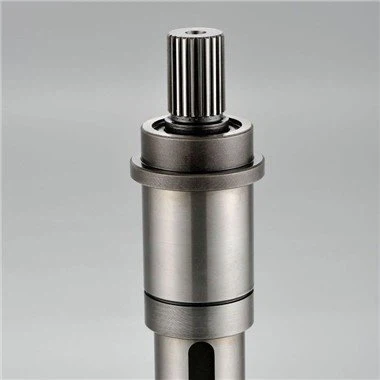 Spindle ShaftA transmission shaft (also known as shaft) is a rotating machine element with circular crossAdd to Inquiry
 -
 Splined ShaftA splined shaft is characterized by the deep grooves, or splines, cut along the entire length ofAdd to Inquiry
 -
 Automotive Transmission Input ShaftThe gearbox input shaft is considerably shorter than the output shaft and fixed to its gear. It isAdd to Inquiry
 -
 Automotive Transmission Counter ShaftThe automotive counter shaft is fixed to its gears and is driven at a constant speed by the engineAdd to Inquiry
 -
 Automotive Transmission Output ShaftThe automotive output shaft is not fixed to its gears. The gearbox output shaft is a simple splinedAdd to Inquiry
 -
 Manual Transmission Input ShaftA manual transmission input shaft is an essential part of the overall transmission that bears theAdd to Inquiry
 -
 Manual Transmission Counter ShaftThis manual transmission counter shaft lies parallel to the main shaft and is forced by the inputAdd to Inquiry


- Tel: +86-579-88301121
- Mob: +86-13858988130
- Email: jhjgcl@sina.com
- Add: ChengNan Industrial District, LanXi, Zhejiang, P.R.C.
Shafts - Key Takeaways
Shaft Types
The article discusses two types of shafts, namely Torsion Shafts and Flexible Shafts. Torsion Shafts work under torsion (twisting), and are crucial for power transmission settings where torque plays a significant role. Flexible Shafts are elastic, designed to transmit power around obstacles. They are useful when it is hard to align the driver and the driven machine straight, or when there is a requirement to change the direction of power transmission.
Shaft Materials
The choice of the material used is critical to the manufacturing of shafts. Different materials include Steel, Cast Iron, and Composites. Each has its own strengths and weaknesses, and the intended application plays a huge part in choosing the correct material.
Shaft Functions
Shafts are an essential part of many machinery, they transmit mechanical power and provide structural support to the rotating elements of a machine. Their central role involves converting types of movement, and indeed controlling the speed of the applicable machine component.
Shaft Design
Designing a shaft needs careful consideration, with factors like size, material, loads, torque, speed, and other factors playing a huge part in the design process. The designed shaft must transfer power effectively while withstanding operational stresses.
Classification of Shafts
Longitudinal shafts
Longitudinal shafts, as the name implies, carry the load along the length of the shaft. They are typically designed to withstand the effects of shearing and bending moments. An admirably high strength level, vis-à-vis other shaft types, makes them a preferred choice in heavy-duty machinery. Notably, these shafts are installed in a wide range of equipment, from automotive to heavy mechanical industries. Their design and manufacturing are primarily based on the mechanics of materials, which allows prediction of their behaviour under different load conditions.
Torsion shafts
Torsion shafts are another fundamental category in mechanical engineering. They work under torsion, that is, twisting. This distinctive feature makes them valuable in power transmission settings where torque plays a significant role. A classic example of a torsion shaft is the driveshaft in an automobile. The rotational motion of an engine's crankshaft is transferred to the driveshaft, which, due to its torsional properties, transmits this power to the automobile's differential and, subsequently, to the wheels. Therefore, the torsion shaft is an essential link in the conversion of the engine's power into the vehicle's motion.
Flexible shafts
Unlike the rigid nature of longitudinal and torsion shafts, flexible shafts are essentially elastic, designed to transmit power around obstacles. They come into play when it is difficult to align the driver and the driven machine straight or when it is a requirement to change the direction of power transmission. Thus, flexibility is their defining feature. A flexible shaft can be seen in everyday applications like drilling machines, flexible screwdrivers, and some medical equipment where power needs to be transferred through bent paths. One must note that while designing flexible shafts, the material's shear modulus is of primary concern. This is because the shaft's flexibility depends on it. Moreover, the material should resist torsional deformation under constant rotation.

In the industrial panorama, the importance of shafts cannot be underestimated. Here are a few reasons why shafts are deemed crucial:
• Shafts play an integral role in power transmission. Without them, it would be impossible for machines to either produce or absorb power.
• They provide mechanical support to gears, pulleys, and the like, thereby facilitating their motion.
• Shafts also play a role in controlling vibrations in a machine, thus preventing any damage from excessive vibration.
It's also important to note that the design and material selection of a shaft can greatly impact its functionality and lifespan. Thus, the process of designing and fabricating a shaft requires deep knowledge of engineering principles and a clear understanding of its application.
Popular Materials Used in Making Shafts
Steel shafts: key characteristics
A remarkably versatile material in the realm of mechanical engineering, steel is a prominent candidate in shaft manufacturing. It's favoured due to an admirable blend of strength, durability, machinability, and availability. Steel shafts are capable of withstanding considerable stress due to their high strength and resilience. Here are some dominant reasons behind the widespread use of steel in shafts:
• Strength: Steel shafts have high tensile and shear strength, making them capable of bearing significant loads.
• Machinability: Steel is easy to work with as it can be cut, shaped, and drilled rather comfortably.
• Durability: With adequate treatment like hardening and tempering or using special steels like stainless steel or alloy steels, the shaft can be made more durable.
• Cost-effectiveness: Given its excellent properties and wide availability, steel is a reasonably economical choice for shafts.
While the merits of steel shafts are compelling, they are not without their pitfalls. One significant drawback is corrosion. In corrosive environments, the metallic nature of steel makes it susceptible to rust and corrosion. This can, however, be mitigated by applying protective coatings or using stainless steel.
Composite shafts
Recently, composite materials have also found a spotlight in shaft manufacturing due to their unique properties of strength, flexibility, and weight. Composite shafts are typically made of a combination of materials, most commonly fibreglass, carbon fibre or other high-strength materials. Composite shafts have become particularly popular due to their impressive strength-to-weight ratio. Even though these shafts are lightweight, they can still bear significant loads, making them an excellent choice for applications where weight reduction is vital, for instance, in aerospace and automotive industries. Here are some other compelling advantages:
• High strength-to-weight ratio: Composite shafts, are significantly lighter than their metal counterparts for the same load-bearing capacity.
• Resistance to corrosion: Unlike metal shafts, composites are not susceptible to corrosion, enabling them to work efficiently in corrosive environments.
• Vibration Damping: Composite materials have inherent damping properties, which can reduce noise and enhance the lifespan of the machinery.
The roles fulfilled by shafts are two-fold; they transmit power and offer crucial support to other machine components. However, delving deeper into these functions, one can appreciate their criticality in mechanical engineering. The central role of transmitting power often involves converting the type of movement - most commonly, the conversion of rotational motion to linear motion or vice versa. Further, they also bear the brunt of varying loads, resisting stresses to maintain stability and reliability of the machine. Shafts also play a crucial part in controlling the speed of the machine component. By connecting gears of different sizes on a shaft, engineers can manipulate the speed and torque of a machine. For instance, a large gear engaged with a smaller gear will result in a decrease in speed but an increase in torque.

Factors to Consider While Designing Shafts
The primary objective of shaft design is the successful transfer of mechanical power. However, it's not as simple as it might initially seem. Engineers have to engage in a meticulous process of considering several factors and overcoming numerous challenges. Here are some elements to consider:
Torque: As power transmission agents, shafts should withstand the operational torque. An ill-prepared shaft can fail under high torque, leading to severe machine damage.
Loads and Stresses: It's crucial to determine the kind of load the shaft will endure - whether torsional, bending, or axial. Following this, calculating the consequent stresses is essential.
Material: The selection of appropriate material impacts every feature of a shaft’s performance including its strength, rigidity, and resistance to wear and tear.
Diameter: Contingent on other factors, the diameter of a shaft can dictate the amount of load and stress it can endure.
Length: The length of a shaft is another important parameter influencing its design and operation.
Speed: The speed at which the shaft rotates impacts its loads and the vibrations it imparts to the system.
Material selection is a critical aspect of shaft design, setting the stage for the shaft's strength, rigidity, and durability. The right material not only provides the shaft with the necessary mechanical properties to resist loads, stresses and wear but also affects its weight and fabrication cost. The ideal material exhibits high strength to endure the loads and stresses that a shaft may encounter in operation, high toughness to absorb energy and resist fracture, and high hardness to immune the shaft from wear, tear and deformation. Several materials are available for shaft production, but the most common ones include carbon steel, alloy steel, stainless steel, and, increasingly, composite materials. Carbon steels offer a good balance between cost-efficiency and mechanical properties. Alloy and stainless steels offer increased strength, corrosion resistance, and toughness. Composite materials, while more expensive, offer great strength-to-weight ratios, making them suitable for high-performance applications. The right choice of material is paramount in ensuring the shaft can fulfil its intended role while offering safety and reliability. Thus, material selection in shaft design shouldn't be overlooked or underestimated but approached meticulously with a considered understanding of its profound impact. Remember, designing a shaft that accurately suits its purpose is not about perfecting one parameter but optimising an array of factors to provide the most efficient and reliable component for your machine.

Automobiles encapsulate the use of shafts in a variety of ways, with its mechanical systems heavily relying on numerous types of shafts to function smoothly. The primary shafts present in an automobile include driveshafts, axles, and camshafts. Driveshafts are long, cylindrical, robust structures designed to carry high torque loads. They connect the vehicle's differential with the gearbox, transmitting power from the engine to the vehicle's wheels, thus driving it forward. Axles, another type of shaft, hold the weight of the vehicle and its load, if any, and transfer the driving forces from the engine to the wheels. The axles rotate with the wheels and hence, need to be extremely rigid and durable. Camshafts operate to control the opening and closing of engine valves, thus, regulating the engine's air-fuel intake and exhaust. These shafts contain several lobes or ‘cams’ that push against the valves or the valve lifters to operate them in sync with the engine's firing rate. These distinct shaft types tailored for specific applications share common properties such as high strength, rigidity, and the competence to withstand considerable torque and bending loads. In the context of automobile manufacturing, the choice of shaft material becomes critical due to the significant loads, stresses, and working conditions encountered. The typical material used for shaft manufacturing in automobiles includes different grades of steel due to their high tenacity and long Fatigue life.
Our Factory
Founded in 1992, JinHua JingGong automotive gear Ltd., Co. was originally established in JinHua, ZheJiang. Major products are transmission gear and gear shaft parts. As a 30-year-old mechanic manufacturing company, the persistency on automotive industry has always driven us to be creative and keep forging ahead. Currently, we have capability to produce 500,000 parts per year and independently develop new transmission gear boxes, and more importantly, we can turn a blueprint into a fact. Holding the IATF 16949 certificate, JingGong is currently a supplier of DFAC. Our products cover full-range of transmission field, including trucks, construction machinery, farm machinery and mining machinery. Also, we have developed transmission parts of first batch EV trucks in China.

Certificate

FAQ
We're professional shaft manufacturers and suppliers in China, specialized in providing high quality customized service. We warmly welcome you to buy high-grade shaft at competitive price from our factory.
compact gear, automotive steering gears, Agricultural Shaft